Vyrqelanox
Anchor Stream
Anchor Stream
Couldn't load pickup availability
1. Problem Statement
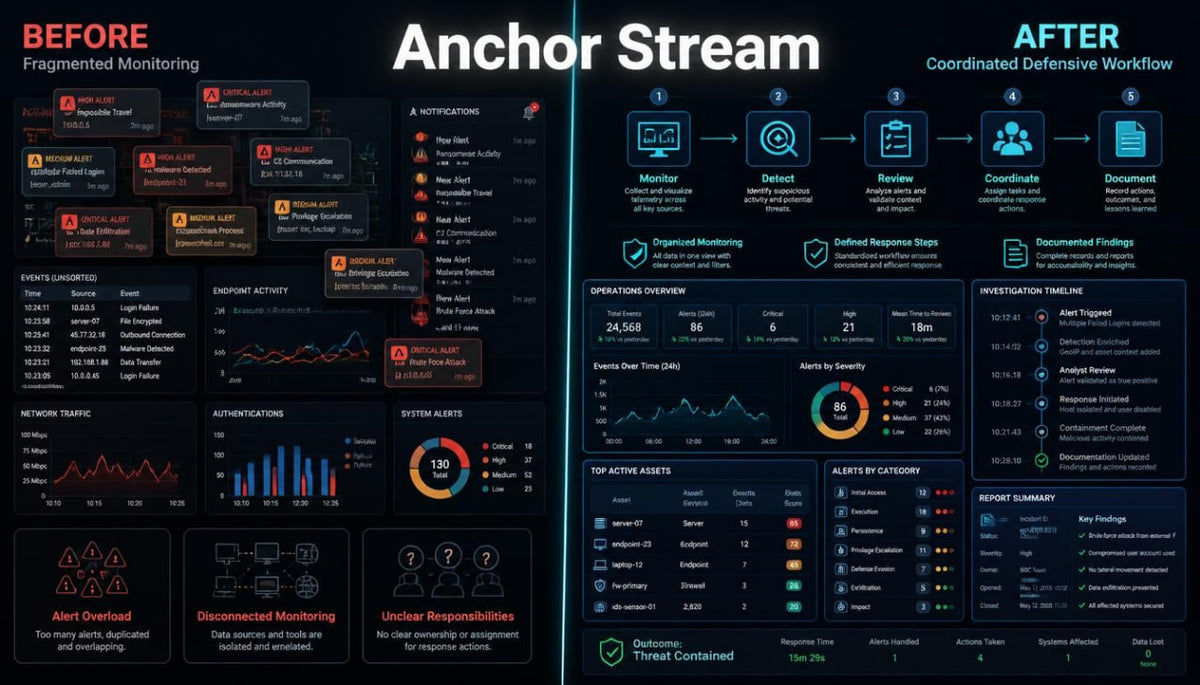
Modern digital environments generate security information from numerous interconnected components and activities. Examining these records separately can make it difficult to recognize relationships between suspicious events. Security teams must also distinguish ordinary operational changes from activities requiring further investigation. Inconsistent documentation and unclear response responsibilities can complicate incident evaluation and defensive coordination. Understanding how monitoring, analysis, and response processes interact provides a foundation for organized cybersecurity operations.
2. Solution
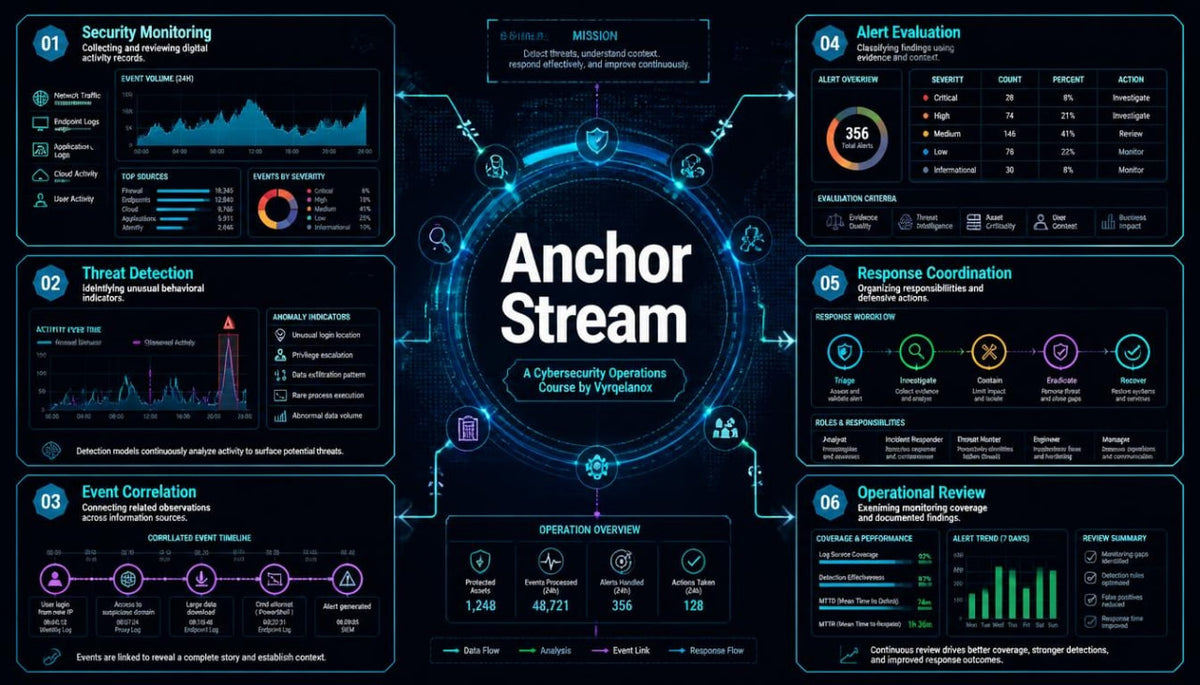
Anchor Stream introduces a structured approach to coordinating cybersecurity monitoring and defensive response procedures. Each module explores a specific operational activity and explains its relationship to broader security workflows. Fictional case studies demonstrate how event observations can be classified, correlated, and examined through defined procedures. Guided exercises encourage learners to evaluate evidence, document findings, and compare defensive decisions. The course connects technical observation with incident coordination, communication practices, and continuous security review.
3. What's Inside
Module 1: Foundations of Security Operations
Explore the purpose of coordinated cybersecurity operations and their role within connected environments. Examine operational responsibilities, information sources, reporting structures, and the relationships between monitoring and response activities.
Module 2: Security Monitoring Architecture
Study how activity records from different components contribute to a broader security overview. Learn about event collection, monitoring coverage, record organization, and the importance of consistent timestamps and identifiers.
Module 3: Threat Detection Principles
Examine how suspicious behavior can be identified through documented observations and behavioral indicators. Review fictional examples involving unusual identity activity, unexpected communication patterns, and configuration changes.
Module 4: Event Correlation and Investigation
Explore methods for connecting related events across multiple information sources. Practice constructing chronological sequences, identifying shared characteristics, and distinguishing recorded evidence from interpretation.
Module 5: Security Alert Evaluation
Study how security alerts can be reviewed and categorized according to available evidence and operational context. Guided activities demonstrate alert classification, prioritization criteria, and investigation documentation.
Module 6: Incident Response Coordination
Examine the organizational side of defensive incident handling. Topics include responsibility assignment, communication procedures, containment considerations, evidence preservation, and coordination between different operational roles.
Module 7: Defensive Workflow Documentation
Learn to prepare structured investigation records containing initial observations, supporting information, decisions, and follow-up activities. Examine how consistent documentation contributes to clear communication.
Module 8: Operational Review and Improvement
Explore methods for reviewing completed investigations and identifying opportunities to refine monitoring procedures. Study recurring observations, documentation gaps, and the evaluation of defensive workflows.
Applied Security Operations Workshop
Analyze a fictional collection of alerts and activity records. Reconstruct an incident timeline, classify observations, document response considerations, and prepare an organized operational review.
Additional materials include event analysis worksheets, workflow diagrams, terminology references, and scenario-based review questions.
4. Who Is This For?
Anchor Stream is intended for learners familiar with cybersecurity foundations, digital event analysis, and introductory incident response concepts. It suits students interested in defensive monitoring, security operations, incident coordination, and technical investigation procedures. The materials support independent study through structured explanations and practical analytical activities.
5. What You'll Learn
-
Describe the structure of cybersecurity operations.
-
Interpret security monitoring information.
-
Identify behavioral indicators in fictional environments.
-
Connect related events from multiple information sources.
-
Classify security alerts using defined criteria.
-
Organize incident investigation timelines.
-
Explain defensive response coordination procedures.
-
Document observations and operational decisions.
-
Evaluate monitoring coverage and workflow gaps.
-
Prepare structured security operations reports.
6. Guarantee
We offer a 30-day money-back guarantee on all paid digital courses and educational materials available through our store.
If you are not satisfied with your purchase, you may request a full refund within 30 calendar days of the original purchase date.
As our courses are delivered digitally, there is no need to return any physical items. Receiving, downloading, or opening the course materials does not affect your eligibility for a refund under this policy.
Refunds will be issued to the original payment method. Processing times may vary depending on your bank or payment provider.
Our 30-day money-back guarantee is provided in addition to your rights under applicable consumer protection laws and does not limit those rights.
Self-paced learning overview
- 📥 Digital file available after purchase
- 📚 Long-term availability
- 🔒 Secure checkout
- 📅 Content updated in 2026
What format are the Vyrqelanox courses provided in?
What format are the Vyrqelanox courses provided in?
All courses are delivered as digital educational materials with organized sections, topic explanations, and practical learning activities. Each tier covers a different range of cybersecurity concepts, allowing learners to choose materials that match their interests and current knowledge.
Can I study the course materials at my own pace?
Can I study the course materials at my own pace?
Yes. Our courses are designed for independent study, allowing you to read, review, and revisit individual modules according to your personal schedule. You can organize your learning sessions around the topics you wish to examine in greater detail.
Do I need previous cybersecurity knowledge to begin?
Do I need previous cybersecurity knowledge to begin?
Previous technical knowledge is not required for our introductory materials. The course collection gradually introduces more detailed subjects, with each tier focusing on particular concepts, techniques, and practical applications. We recommend reviewing the course descriptions to understand the topics covered.
Share