Vyrqelanox
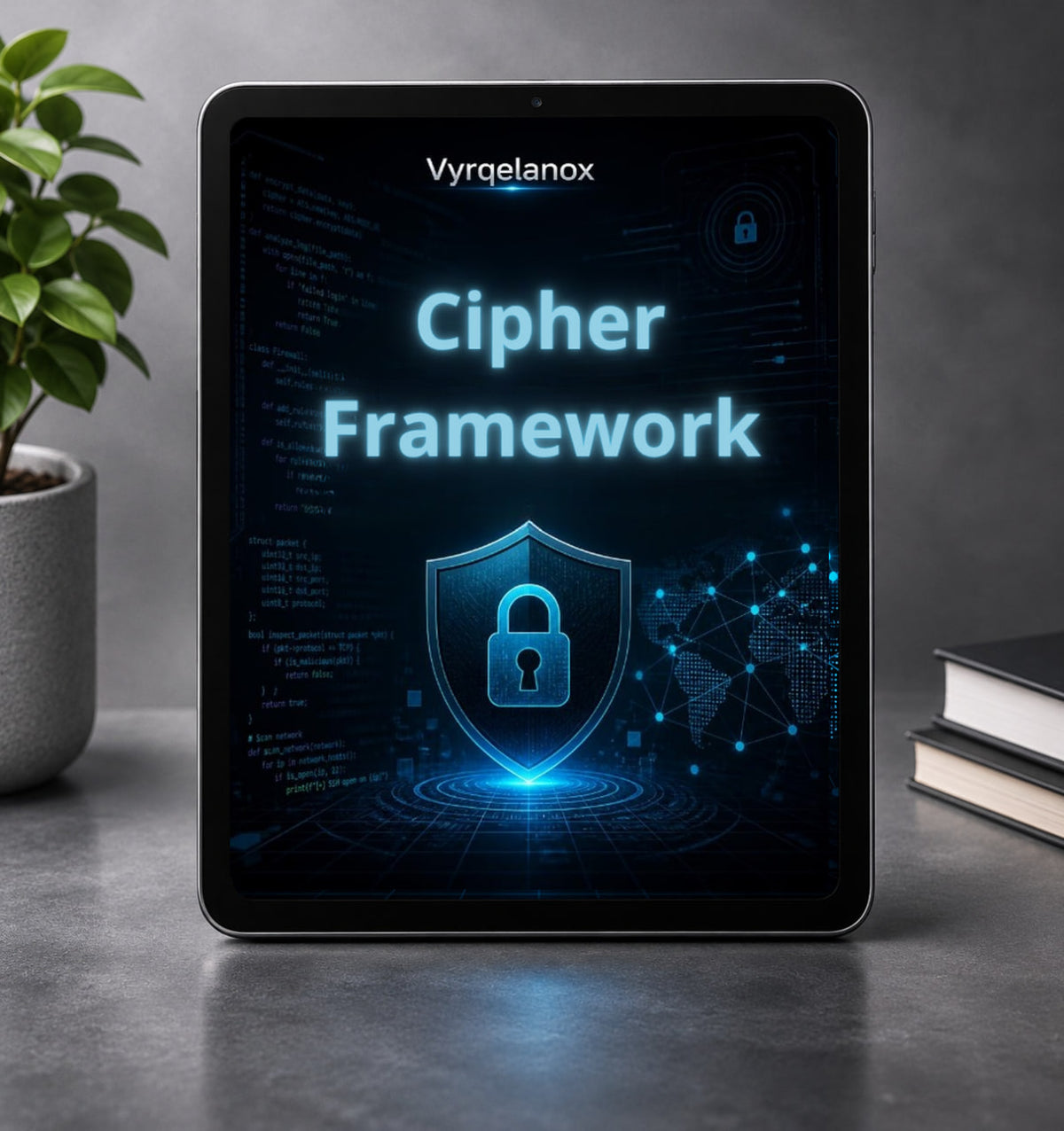
Cipher Framework
Cipher Framework
Couldn't load pickup availability
1. Problem Statement
Digital environments regularly process information that requires careful protection against unauthorized viewing or modification. Understanding security boundaries alone does not fully explain how information remains protected during storage and communication. Different protection methods address different concerns, making their purposes and relationships important to understand. Learners may encounter encryption terminology and integrity mechanisms without knowing how these concepts fit into broader defensive structures. A structured learning approach helps connect information protection principles with practical cybersecurity decisions.
2. Solution
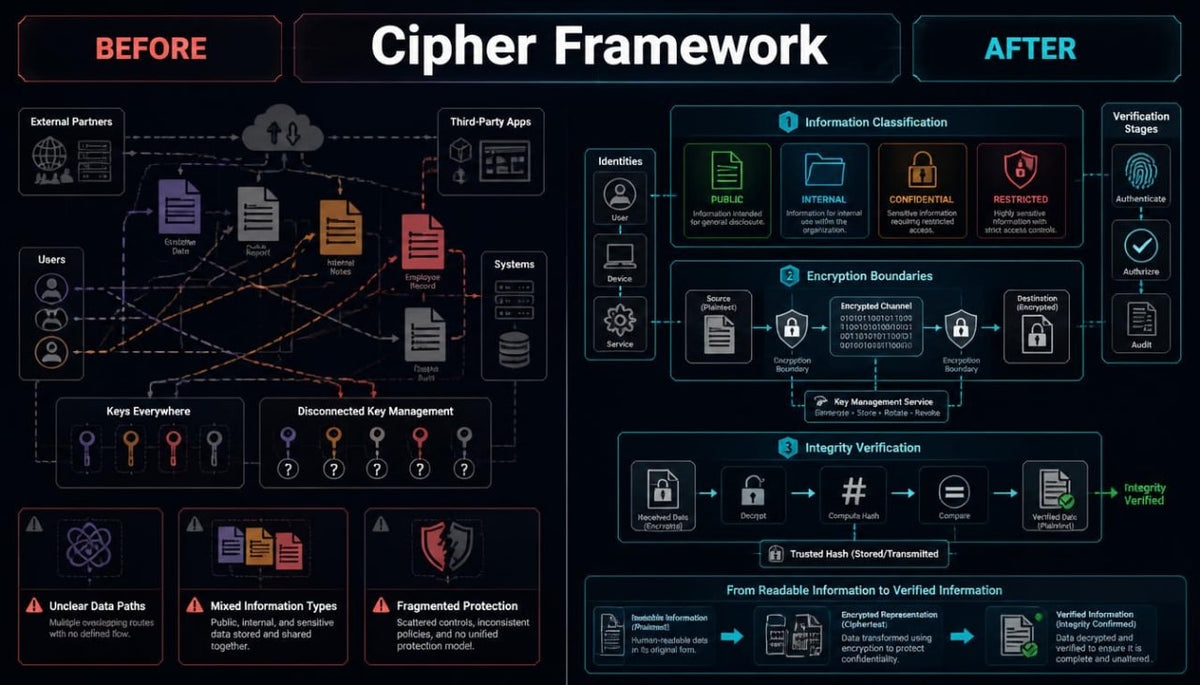
Cipher Framework introduces fundamental information protection concepts through organized explanations and guided analysis. Each module examines specific security mechanisms and their roles in handling sensitive information. Fictional scenarios demonstrate how information can be protected, verified, and managed throughout its lifecycle. Practical activities encourage learners to compare protective methods and identify relevant security considerations. The course connects theoretical principles with defensive planning and responsible information handling.
3. What's Inside
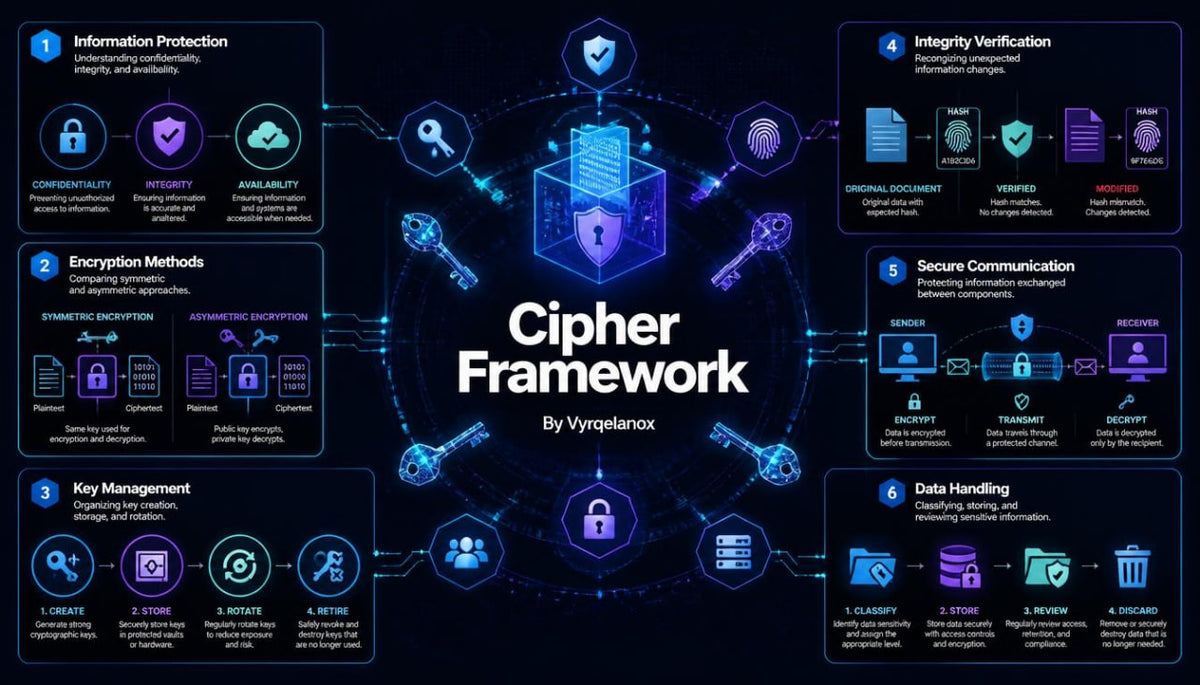
Module 1: Foundations of Information Protection
Explore confidentiality, integrity, and availability as interconnected security objectives. Examine how information sensitivity influences protection requirements and defensive decisions.
Module 2: Understanding Encryption Principles
Study the purpose of encryption and the relationship between readable information and its protected representation. Learn about symmetric and asymmetric methods through conceptual examples and illustrated communication scenarios.
Module 3: Encryption Key Management
Examine how encryption keys are created, stored, shared, rotated, and retired. Review fictional situations demonstrating why careful key handling matters throughout the information lifecycle.
Module 4: Information Integrity and Verification
Explore integrity checking, digital fingerprints, and methods for recognizing unexpected information changes. Guided examples demonstrate how verification mechanisms support reliable information handling.
Module 5: Secure Communication Concepts
Examine the protection of information exchanged between connected components. Study communication boundaries, identity verification, protected channels, and introductory certificate concepts.
Module 6: Data Storage and Handling
Review methods for organizing and protecting stored information. Topics include information classification, encryption considerations, retention planning, and responsible disposal procedures.
Module 7: Protective Design Review
Analyze fictional environments containing information repositories and connected communication paths. Compare protection arrangements and identify circumstances requiring additional defensive review.
Applied Learning Workshop
Complete information classification exercises, communication diagrams, integrity review scenarios, and a structured protection assessment using fictional case materials.
4. Who Is This For?
Cipher Framework is intended for learners who understand introductory cybersecurity architecture and want to examine information protection mechanisms in greater detail. It suits students interested in encryption concepts, information integrity, secure communication, and defensive system planning. Familiarity with connected environments and basic security terminology is recommended.
5. What You'll Learn
-
Explain confidentiality, integrity, and availability principles.
-
Distinguish symmetric and asymmetric encryption methods.
-
Describe fundamental encryption key management practices.
-
Examine information integrity verification techniques.
-
Identify security considerations in digital communication.
-
Recognize information classification requirements.
-
Compare protective storage and communication methods.
-
Interpret introductory security architecture diagrams.
-
Document information protection observations.
-
Evaluate fictional data-handling scenarios.
6. Guarantee
We offer a 30-day money-back guarantee on all paid digital courses and educational materials available through our store.
If you are not satisfied with your purchase, you may request a full refund within 30 calendar days of the original purchase date.
As our courses are delivered digitally, there is no need to return any physical items. Receiving, downloading, or opening the course materials does not affect your eligibility for a refund under this policy.
Refunds will be issued to the original payment method. Processing times may vary depending on your bank or payment provider.
Our 30-day money-back guarantee is provided in addition to your rights under applicable consumer protection laws and does not limit those rights.
Self-paced learning overview
- 📥 Digital file available after purchase
- 📚 Long-term availability
- 🔒 Secure checkout
- 📅 Content updated in 2026
What format are the Vyrqelanox courses provided in?
What format are the Vyrqelanox courses provided in?
All courses are delivered as digital educational materials with organized sections, topic explanations, and practical learning activities. Each tier covers a different range of cybersecurity concepts, allowing learners to choose materials that match their interests and current knowledge.
Can I study the course materials at my own pace?
Can I study the course materials at my own pace?
Yes. Our courses are designed for independent study, allowing you to read, review, and revisit individual modules according to your personal schedule. You can organize your learning sessions around the topics you wish to examine in greater detail.
Do I need previous cybersecurity knowledge to begin?
Do I need previous cybersecurity knowledge to begin?
Previous technical knowledge is not required for our introductory materials. The course collection gradually introduces more detailed subjects, with each tier focusing on particular concepts, techniques, and practical applications. We recommend reviewing the course descriptions to understand the topics covered.
Share